Friday, August 11, 2017

The Power of Play----Science and Nature 8/11/2017

For young learners, science is just an extension of their everyday world. We don’t have to teach young children how to wonder, discover, and explore through play because they do it naturally.

When people say they don’t like science, it’s most likely because of a bad experience they had as a child. It was the experience that shaped their negative opinion. That’s why it’s so important to our teachers and staff at AoSL to focus on creating amazing experiences that encourage discovery through play, asking questions, exploration and using creativity to solve simple problems. Amazing experiences turn into unforgettable learning experiences that can inspire and motivate children to want to learn and explore more on their own!

Mr. Bond the Science guy came to visit during our Power of Play summer, creating one of those unbelievable, unforgettable experiences for our young scientists! 


Popsicle Days at Seaboard Lane! 8/11/2017

Summer just isn't complete without popsicles! Our friends at AoSL were able to beat the summer heat with a tasty cool treat! Toddlers through Pre K 2 enjoyed 100% fruit juice pops, 100% fruit juice popsicles, and Luigi's Italian Ice. Yummy! Yummy!


Thursday, August 3, 2017

The Power Of Sensory 7/31/2017

From birth through to early childhood, children use their senses to explore and try to make sense of the world around them. They do this by touching, tasting, smelling, seeing, moving and hearing.

 Sensory play includes any activity that stimulates your young child's senses: touch, smell, taste, movement, balance, sight and hearing.

Sensory activities facilitate exploration and naturally encourage children to use scientific processes while they play, create, investigate and explore. The sensory activities allow children to refine their thresholds for different sensory information helping their brain to create stronger connections to process and respond to sensory information.


Touch---Touch is a powerful learning tool for enhancing early emotional learning. 

Sensory seeking children frequently experience sensory cravings, where they simply can’t get enough of anything. They are constantly searching for ways to stimulate their nervous systems.

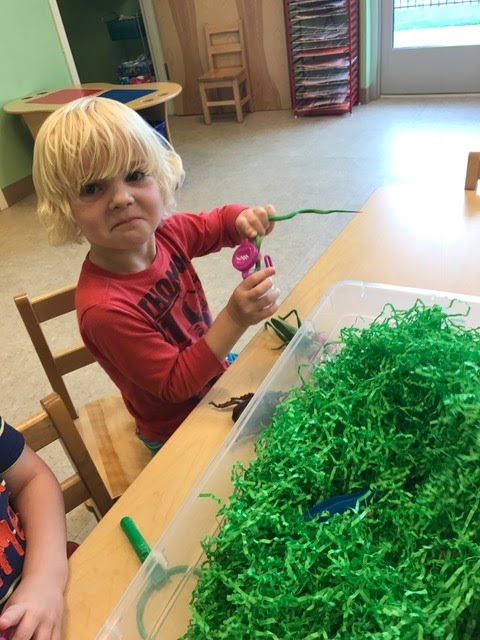
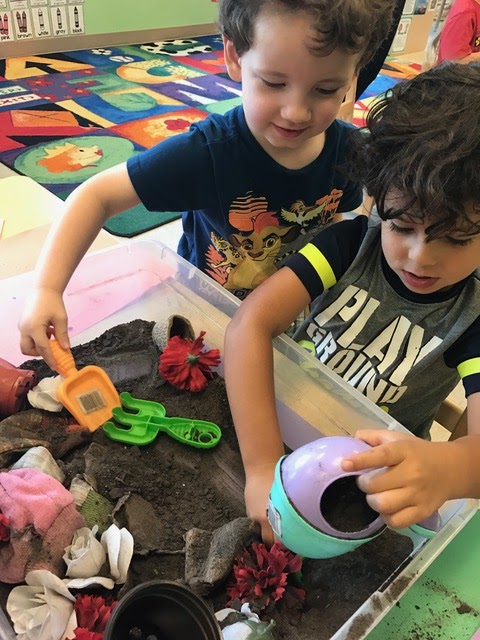
Our friends at Seaboard Lane have explored sensory by playing in the many different sensory bins we have. They have discovered the grasslands, with the faux grass and wild animal bin, been gardeners, with our soil and flower bin, traveled the Jurassic era, with the rock and dinosaur bin, and swam the ocean blue, with our water and whale bin. What a fun week?!


Thursday, July 20, 2017

The Power of MOVEMENT! 7/20/2017

 Movement can help children develop, not only physically but emotionally and socially as well. Their well-being can be greatly enhanced if they are given simple foundations in all areas during their early years. These foundations will carry through as they continue to develop and learn at home and at school. Physical fitness may involve simple stretching, bending, twisting, and other body movements.Young children do not have the need for highly complicated motor or play activities. They are learning at the very basic and fundamental level, and activities can be very simple and singular in nature. There is not the need for competition or highly organized games. Less organized, slower paced, and more exploratory activities are very appropriate for young children.
 Research has shown time and again that children need opportunities to move at home and in class. Memory and movement are linked, and the body is a tool of learning, not a roadblock to or a detour away from it. 
This week we encouraged all of our families to simply "get moving." Here is just one of the many submissions! They enjoyed a fun night in their backyard on their trampoline. Sometimes the very basic of activities are the absolute BEST! 


Thursday, July 13, 2017

The Power of ART 7/13/2017

At The Academy we cannot express enough the importance of ART. Art not only lets children explore their inner creativeness, it also has several developmental benefits. Just a few are listed below:


Art Helps Develop Motor Skills: Many of the motions involved in making art, such as holding a paintbrush or scribbling with a crayon, are essential to the growth of fine motor skills in young children.

Art Helps Promote Language Development: For very young children, making art—or just talking about it—provides opportunities to learn words for colors, shapes and actions. 

Art Helps With Decision Making: Art education strengthens problem-solving and critical-thinking skills. 

Art Is Visual Learning: Drawing, sculpting with clay and threading beads on a string all develop visual-spatial skills, which are more important than ever. 

During Art Week, we explored creating art with several different art mediums, painted with different tools, sculptured with clay, made murals, and had PLENTY of free art! Take a look at some of the creativity that came about during a fantastic week! 

 Pre K creating their very own classroom mural.
 Pre K creating their very own classroom mural.
 Pre K creating their very own classroom mural.
 Pre K creating their very own classroom mural.
 Preschool 1 painting an outline of their bodies!
  Preschool 1 painting an outline of their bodies!
  Preschool 1 painting an outline of their bodies!
  Preschool 1 painting an outline of their bodies!
  Preschool 1 painting an outline of their bodies!

KBC School Bus Safety! 7/13/2017

Our final guest visitor of the summer during Kindergarten Boot Camp was a school bus driver, from a local school. School buses are one of the safest way for students to travel, but children also need to do their part to stay alert and aware of their surroundings to prevent injury. We urge our parents to teach their cadets the following safety rules for getting on and off the bus, and for exercising good behavior while riding.


 Getting on the Bus:
  • When waiting for the bus, stay away from traffic and avoid roughhousing
  • Do not stray onto the street, alleys or private property
  • Line up away from the street or road as the bus approaches
  • Wait until the bus has stopped and the door opens before approaching the bus
  • Use the handrail when boarding
Behavior on the Bus:
  • If seat belts are available on the bus, buckle up
  • Don't speak loudly or make loud noises that could distract the driver
  • Stay in your seat
  • Don't put your head, arms or hands out the window
  • Keep aisles clear of books and bags
  • Get your belongings together before reaching your stop
  • Wait for the bus to stop completely before getting up from your seat
Getting Off the Bus:
  • Use the handrail when exiting
  • If you have to cross in front of the bus, first walk at least 10 feet ahead until you can see the driver
  • Make sure the driver can see you
  • Wait for a signal from the driver before crossing
  • When the driver signals, look left, right, then left again. Walk across the road and keep an eye out for sudden traffic changes
  • If your vision is blocked, move to an area where you can see other drivers and they can see you
  • Do not cross the center line of the road until the driver signals it is safe
  • Stay away from the rear wheels of the bus at all times
Special thanks to our BGA Family for speaking with our cadets on the importance of staying safe while waiting on the bus, getting on the bus, riding the bus, and getting off the bus.  Next stop...PRE K GRADUATION!


Thursday, July 6, 2017

The Importance of PE, with the help of our KBC Cadets! 7/6/2017


Physical activity is important to many aspects of child health and development. 
In young children, lack of physical activity is a risk factor for many health problems such as high blood pressure, weight gain, excess body fat, bad cholesterol, respiratory difficulties, cardiovascular diseases, and bone health problems. Moreover, the health benefits of physical activity extend well beyond physical health, having a positive impact on the domains of motor skills, psychological well-being, cognitive development, social competence and emotional maturity. We are thrilled to be active everyday at Seaboard Lane, but it is even more exciting when we have special guest visitors. 
 
Coach Wells, from a local neighboring school, came to discuss with our KBC cadets the importance of physical education while in kindergarten and throughout life. He brought along some really cool sporting equipment and even explained the importance of good sportsmanship. Thank you Coach Wells!  


.

Thursday, June 29, 2017

There's so much more to PLAY than just PLAY 6/29/2017


Pretend play is more than fun—it helps develop thinking and problem-solving skills and strengthens social and communication skills, as well. It lets children "try on" endless new roles and new ways of looking at the world, which helps build empathy and imagination. And as imagination develops, children's interest and involvement in make-believe and pretend play will grow. Pretend play is a major developmental milestone! 
PLAY IS THE HIGHEST FORM OF RESEARCH. 
At AoSL we wholeheartedly believe in 
THE POWER OF PLAY! 


KBC Special Guest Visit 6/29/2017

During Kindergarten Boot Camp, our cadets not only focus on often time overlooked skills, such as carrying a lunch tray, opening milk cartons and ketchup packets, remembering addresses and phone numbers, and discussing school bus safety, we also give them a chance to put their kindergarten fears aside by speaking with an actual kindergarten teacher. Mrs. Martin, a local kindergarten teacher, came out this morning to talk with our cadets about life in "big kid" school. Needless to say, dozens of questions were answered, and our cadets can rest assured, knowing that elementary school, kindergarten in particular, is very similar to Pre-K, with only a few changes. They will tackle the new school year with ease after their discussion and a special book selection from Mrs. Martin----Miss Bindergarten's Kindergarten. 


Thursday, June 15, 2017

The Power of Imagination! 6/15/2017

"Everything you can imagine is real."--Pablo Picasso. 
Imagination is the door to possibilities. It is where creativity, ingenuity, and thinking outside the box begin for child development. ... Imagining, trying new ways of doing things, and experimenting help develop critical thinking in children and foster creative problem solving. 
Imagination week has been so much fun. Check out our family-driven Power of Play night, featuring edible, imagination graham cracker faces and our Pre K car wash!